Prof. Wojciech Knap
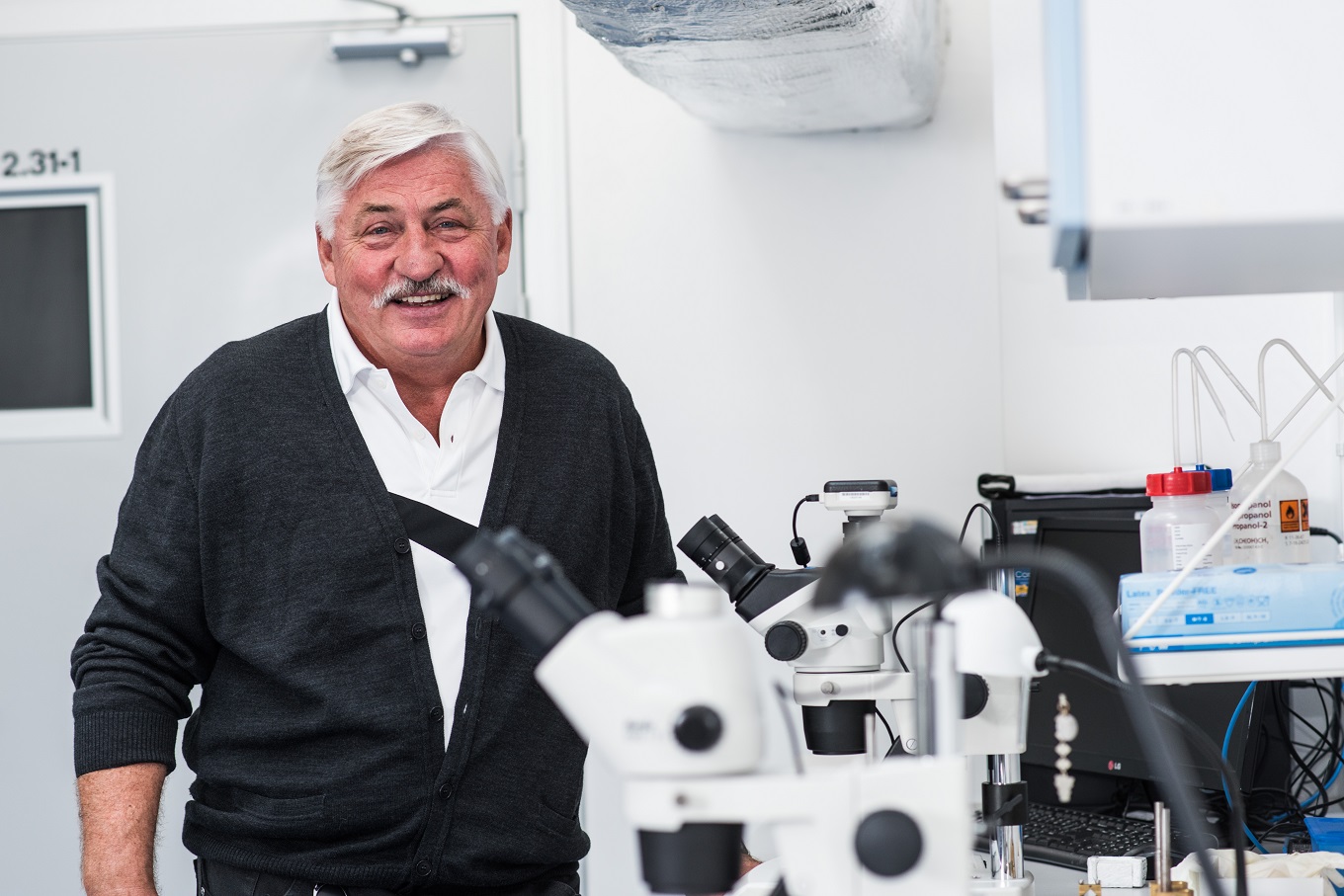
Wojciech Knap graduated in physics from the University of Warsaw in 1979, and six years later earned his doctorate on semiconductors operating in the terahertz range. After several years at his alma mater, he moved to France, where he became associated with the University of Montpellier, followed by the Grenoble High Magnetic Field Laboratory and the Toulouse Pulsed Magnetic Field Laboratory. He gained international experience as a visiting researcher at Rensselaer Polytechnic Institute in Troy (USA) and Tohoku University in Sendai (Japan). In 1992, Wojciech Knap became a professor and research director at the French National Centre for Scientific Research (CNRS) in Montpellier, and since 2005, he has led a research group working on terahertz technologies at the Charles Coulomb Laboratory. He was awarded the title of professor in Poland in 2013.
Since 2013, Prof. Knap has been affiliated with the Institute of High Pressure Physics of the Polish Academy of Sciences, where he established the Terahertz Radiation Laboratory. In 2018, he established the CENTERA – Center for Terahertz Research and Applications, and in 2023 he opened CENTERA 2 at the Warsaw University of Technology. The Center conducts R&D research on fundamental and application aspects of terahertz phenomena. The Foundation for Polish Science co-funds the research from European funds under the framework of the International Research Agendas Programme.
Prof. Knap’s scientific interests include semiconductor physics in far-infrared (terahertz radiation), plasmonics of nanostructures and two-dimensional materials, and the use of collective phenomena (plasmons, magnons) in designing new detectors and generators of terahertz radiation. The scientific output of Prof. Knap encompasses more than 740 scientific articles with more than 18,500 citations. He is also the author or co-author of numerous patents. Prof. Knap was the initiator and coordinator of international research networks dedicated to terahertz radiation physics, including the GDR network in France and the TERAMIR collaboration (France-Poland-Russia). He also initiated the creation of the spin-off company “Terakalis,” which implements terahertz technology for industrial applications. In 2022, his TERAPLASM project received one of Europe’s most prestigious awards, namely an ERC Advanced Grant from the European Research Council.
Professor Knap has served on the editorial boards of European Physical Journal – Applied Physics and Electronics (MDPI) and as a reviewer for journals such as Nature, Applied Physics Letters, and Journal of Applied Physics. He has earned numerous distinctions in France, Poland, and Japan, as well as research fellowships from Tohoku University and the RIKEN Institute in Japan. Prof. Knap was the recipient of the TEAM Programme of the Foundation for Polish Science.
Terahertz (THz) waves, which are located between microwaves and infrared light, were, until recently, almost inaccessible to engineers, even though astronomers have used them for decades to observe distant regions of the universe. The work of Prof. Knap and his team aims to open the way to their practical application in the “terrestrial” technologies of the future. Today, terahertz radiation is one of the most promising areas of physics and materials engineering. The potential of THz is enormous: this radiation could find applications in non-contact medical or industrial diagnostics, security screening, and high-speed wireless communication. Professor Knap is one of the world’s leading researchers in terahertz plasmonics, a field that combines semiconductor physics, optoelectronics, and nanotechnology.
Terahertz waves possess extraordinary properties. They penetrate paper, fabric, plastic, and wood, but are blocked by metals and water. They are harmless to humans and can therefore be used in medical diagnostics or industrial product scanning – without the need for X-rays. What is more, THz radiation can carry far more data than the frequencies currently used in 4G networks, and future generations of wireless communication, such as 5G and 6G, will rely on it as a carrier of information. This will make it possible to transmit huge amounts of data in near real time, potentially transforming industry, medicine, transportation, and telecommunications.
The research of Prof. Knap has led to the development of new methods of receiving terahertz waves. The research team has achieved this breakthrough through the use of special transistors, namely small electronic components in which electrons confined to a small volume oscillate extremely fast, forming terahertz plasma waves in a two-dimensional electron gas. In practice, this means that Prof. Knap has found a method of using these ultrafast transistors to efficiently detect THz waves. Work is currently underway to use the same transistors for amplifying and generating THz radiation.
Professor Knap (together with a team of researchers from Tohoku University in Japan) has also shown that terahertz waves can be amplified at room temperature using specially designed graphene nanostructures. This is a breakthrough, as until now it was thought that such effects could only be achieved at cryogenic temperatures (commonly defined as below −150°C). Graphene, a material composed of a single layer of carbon atoms, has unique electrical properties. In the structures that Prof. Knap's team studies, it was possible to induce the phenomenon of so-called plasmon oscillations, namely electron waves that can amplify THz radiation. This discovery opened the way to the development of a new generation of voltage-controlled THz amplifiers – devices that are fast, energy-efficient, and compact.
One of the world’s leading centers for terahertz physics is the Center for Terahertz Research and Applications CENTERA in Warsaw. Founded on the initiative of Prof. Knap, the Center was first established at the Institute of High Pressure Physics of the Polish Academy of Sciences, and now operates within CEZAMAT at the Warsaw University of Technology. The Center is co-funded by the Foundation for Polish Science under the International Research Agendas Programme. CENTERA conducts interdisciplinary research into the application of THz wave generation, emission, and detection methods. Scientists are working to develop breakthrough technologies using terahertz radiation, such as high-speed scanners, chemical analyzers, and next-generation communication systems. Until now, the high cost and large size of THz wave generators have posed significant obstacles. Prof. Knap’s team is working on their miniaturization and adaptation for mass production using low-cost semiconductor technologies known from conventional transistors and integrated circuits.
Prof. Knap’s research is one of the cornerstones of the development of terahertz technology worldwide – both at the level of fundamental condensed-matter physics and practical applications, including ultrafast wireless communications. Thanks to his visionary achievements, terahertz radiation is gaining real application potential, and Poland is currently at the forefront of global research in this field.
